






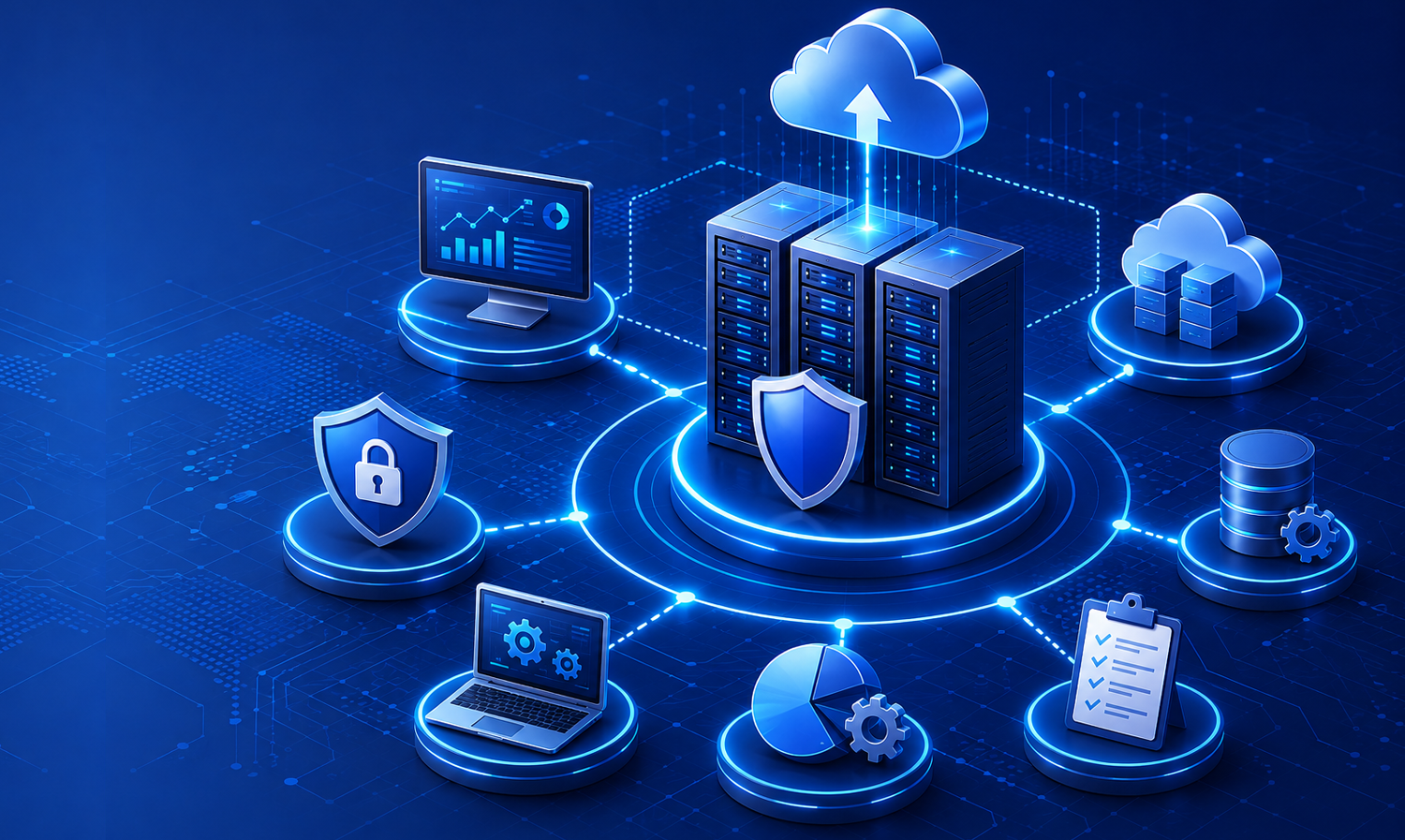
IT Infrastructure Management: What It Means for Modern Businesses
Your IT infrastructure is the foundation behind applications, data, connectivity, employee productivity, customer experiences, and day-to-day operations.
When the infrastructure becomes difficult to monitor, maintain, secure, or scale, minor technology issues can quickly trigger business problems.
IT infrastructure management is the process of monitoring, maintaining, securing, supporting, and optimizing an organization’s technology environment. It ensures that servers, networks, storage, databases, software, cloud platforms, security controls, backup systems, and operational processes run smoothly and remain aligned with business needs.
The challenge for modern IT teams is no longer simply keeping systems online. They also need visibility across hybrid environments, predictable performance, controlled costs, strong security, reliable recovery, and an infrastructure strategy that can support business growth.
This guide explains nine practical IT infrastructure management best practices, the common challenges organizations face, and how to identify opportunities for infrastructure optimization and modernization.
Quick Takeaways
- Proactive monitoring helps IT teams identify infrastructure issues earlier.
- Standardization reduces configuration inconsistencies and simplifies operations.
- Backups and tested disaster recovery processes support business continuity.
- Regular infrastructure assessments reveal performance, security, capacity, and compliance gaps.
- High availability and redundancy reduce dependency on single points of failure.
- Patch and update management helps reduce exposure to known vulnerabilities.
- Vendor and service desk processes directly affect infrastructure operations.
- Security and compliance should be built into infrastructure management rather than treated as separate activities.
- Modernization should be driven by business requirements, operational gaps, scalability, and long-term technology goals.
Is Your IT Infrastructure Ready to Scale?
What Does IT Infrastructure Management Include?
Effective enterprise IT infrastructure management combines technology, people, processes, and operational controls.
The exact scope varies by organization, but commonly includes:
- Server and operating system management
- Network and connectivity management
- Cloud and hybrid infrastructure management
- Storage and database management
- Backup and disaster recovery
- Infrastructure monitoring and performance management
- Security, patch, and vulnerability management
- IT service desk and incident management
- Asset and vendor management
- Compliance and infrastructure audits
- Capacity planning and infrastructure optimization
A mature infrastructure management approach connects the above areas instead of managing each component in isolation.
For example, monitoring can identify a capacity issue, service desk data can reveal recurring incidents, and an infrastructure assessment can turn those findings into an optimization or modernization roadmap.
Why IT Infrastructure Management Matters
Infrastructure decisions have a direct effect on reliability, productivity, security, and operating costs. A reactive approach often means teams spend most of their time responding to incidents.
A proactive approach creates visibility, establishes standards, and uses data to prioritize improvements.
The Business Impact of Strong Infrastructure Management
| Infrastructure focus | Business outcome |
| Monitoring and maintenance | Earlier detection of issues and more predictable operations |
| Capacity and resource optimization | Better utilization and improved cost visibility |
| Security and patch management | Reduced exposure to infrastructure vulnerabilities |
| Backup and disaster recovery | Stronger recovery readiness and business continuity |
| Standardization | More consistent deployments, support, and troubleshooting |
| Modernization | Infrastructure better aligned with changing business requirements |
9 Best Practices for Effective IT Infrastructure Management
Standardize Infrastructure, Configurations, and Processes

Inconsistent configurations make infrastructure harder to manage and troubleshoot. Establishing standards for deployment, naming, documentation, security controls, monitoring, and maintenance creates a more predictable operating environment.
Standardization is especially valuable across enterprise and hybrid environments where multiple teams, locations, platforms, or vendors may be involved.
What to standardize
- Configuration baselines
- Deployment procedures
- Infrastructure documentation
- Monitoring and alerting standards
- Access and security controls
- Change and maintenance procedures
Once standards are established, automation can be introduced where it provides measurable operational value.
Use Proactive Infrastructure Monitoring

Infrastructure monitoring should provide visibility into the health and performance of critical systems before users experience major disruption. Depending on the environment, teams may monitor server resources, network utilization, storage capacity, application response times, availability, and security events.
The goal is not to collect more alerts. The goal is to identify meaningful signals, establish appropriate thresholds, understand dependencies, and define clear response processes.
A practical monitoring cycle
Monitor → Detect → Investigate → Resolve → Learn → Improve
Incident and monitoring data should also feed capacity planning, maintenance, and infrastructure optimization decisions.
Seeing Recurring Performance or Downtime Issues?
Build a Tested Backup and Disaster Recovery Strategy

Backups protect data, but recovery planning determines how quickly critical operations can be restored. Organizations should define backup frequency, retention, storage locations, recovery priorities, responsibilities, and recovery objectives for important systems.
Disaster recovery plans should be tested rather than treated as documents that are only reviewed after an incident. Recovery exercises can reveal missing dependencies, outdated procedures, insufficient capacity, or unrealistic recovery expectations.
Include these areas in your recovery plan
- Critical applications and infrastructure
- Data and backup dependencies
- Recovery priorities
- Recovery procedures and ownership
- Testing schedule
- Recovery time and data-loss objectives
- Communication and escalation processes
Perform Regular IT Infrastructure Audits and Assessments

The infrastructure environment changes continuously. New cloud resources, applications, users, devices, integrations, and security requirements can create gaps that are not visible during day-to-day operations.
Regular IT infrastructure audits and assessments provide a structured way to evaluate the health, performance, security, utilization, resilience, and scalability of the environment.
An infrastructure assessment can examine
- Infrastructure architecture and dependencies
- Server and network performance
- Resource utilization and capacity
- Security and access controls
- Patch and vulnerability status
- Backup and disaster recovery readiness
- Cloud and hybrid environment configuration
- Legacy technology and modernization opportunities
- Operational processes and documentation
The output should not be a list of problems alone. It should help stakeholders prioritize actions based on business impact, risk, cost, and urgency.
Don't Know Where Your Infrastructure Gaps Are?
Design for Redundancy and High Availability

Critical workloads should be evaluated for single points of failure. Where availability requirements justify it, organizations can use redundancy, failover, load balancing, resilient storage, or alternate connectivity to reduce the impact of component failures.
High availability should be designed around business requirements rather than applied uniformly to every system. Start by identifying which applications and services are most critical and what level of disruption the business can tolerate.
Strengthen Patch and Update Management

Patch management is a core part of IT infrastructure maintenance and security. A consistent process should identify applicable updates, prioritize critical fixes, test changes where appropriate, deploy them across relevant assets, and verify completion.
A current asset inventory is essential. Without knowing which systems exist and their patch status, organizations can leave important infrastructure outside the update process.
A practical patch process
Inventory → Assess risk → Prioritize → Test → Deploy → Validate → Report
Manage IT Vendors Against Clear Outcomes

Infrastructure environments often depend on cloud providers, software vendors, hardware suppliers, connectivity providers, and managed service partners. Vendor management should therefore be part of the overall infrastructure operating model.
Define service expectations, SLAs, security requirements, escalation paths, review cycles, and measurable performance indicators. Regular reviews help organizations identify service gaps and ensure vendor relationships continue to support business requirements.
Connect Service Desk Operations With Infrastructure Management

The service desk sees many of the operational issues users experience first. When service desk data is connected to infrastructure monitoring and management processes, organizations can identify recurring incidents and address underlying causes instead of repeatedly treating symptoms.
Useful service desk metrics include
- Incident volume and trends
- Mean time to resolve
- Recurring incidents
- SLA performance
- Request categories
- Escalation rates
- User-impacting infrastructure issues
This creates a feedback loop between users, support teams, and infrastructure operations.
Integrate Security and Compliance Into Infrastructure Management

Security should be embedded in infrastructure processes from design through operations. Infrastructure teams should consider access controls, patching, vulnerability management, logging, monitoring, data protection, backup security, and applicable compliance requirements.
Organizations may need to address requirements associated with frameworks or regulations such as ISO 27001, GDPR, HIPAA, or other applicable standards. The specific controls should reflect the organization’s industry, geography, data, and risk profile.
Regular reviews help identify gaps and keep infrastructure controls aligned with changing technology and compliance requirements.
What Solving Infrastructure Complexity Looks Like in Practice
A real-world example of how organizations addressed downtime risks, improved system reliability, and created a scalable infrastructure foundation across hybrid environments.
How to Manage IT Infrastructure Effectively
Organizations can manage IT infrastructure more effectively by moving from reactive issue resolution to a continuous improvement model.
A Practical IT Infrastructure Management Framework
- Assess Understand the current environment, dependencies, risks, costs, and business requirements.
- Prioritize Identify the issues and opportunities with the greatest business impact.
- Standardize Establish consistent configurations, processes, controls, and documentation
- Monitor Create visibility into availability, performance, capacity, and security.
- Optimize Improve utilization, processes, architecture, and operational efficiency.
- Modernize Transform legacy or constrained environments where modernization supports business goals.
- Measure Track outcomes and continuously refine the operating model.
This approach turns infrastructure management into an ongoing business capability rather than a collection of disconnected IT tasks.
When Should You Consider IT Infrastructure Modernization?
Infrastructure modernization may be appropriate when legacy systems limit scalability, operating costs continue to increase, security requirements are difficult to meet, or the current architecture cannot support new business initiatives.
Modernization can include cloud migration, infrastructure optimization, architecture changes, automation, application modernization, or transformation of legacy environments.
Common Signals That Modernization May Be Needed
- Frequent infrastructure incidents
- Limited scalability
- High operational or maintenance costs
- Legacy systems that are difficult to integrate
- Insufficient monitoring or visibility
- Growing security and compliance requirements
- Manual processes that could be automated
- Difficulty supporting hybrid or distributed environments
Modernization should begin with an assessment of the current environment and a clear understanding of the business outcomes the organization needs to achieve.
Preparing Your Infrastructure for What Comes Next
IT Infrastructure Management: Assessment Checklist
Before starting a major infrastructure improvement initiative, use this checklist to identify areas that may require attention.
| Area | Questions to Ask | Potential Action |
| Visibility | Do we have a clear view of infrastructure health and dependencies? | Improve monitoring and documentation |
| Performance | Are recurring performance issues or capacity constraints affecting users? | Conduct performance and capacity review |
| Security | Are critical assets patched, monitored, and protected by appropriate controls? | Perform security assessment |
| Recovery | Can critical systems and data be restored within business requirements? | Test and improve recovery processes |
| Operations | Are configurations, changes, and support processes standardized? | Establish operating standards |
| Cost | Are infrastructure resources appropriately utilized? | Review capacity and optimization opportunities |
| Scalability | Can the environment support expected business growth? | Develop capacity or modernization plan |
| Modernization | Are legacy systems limiting agility or integration? | Create a modernization roadmap |
How HexaCorp Can Help With IT Infrastructure Management
Infrastructure challenges rarely exist in isolation. A performance issue may be related to capacity, architecture, configuration, monitoring, legacy technology, or an operational process.
HexaCorp can help organizations evaluate infrastructure environments and identify opportunities across assessment, performance improvement, hybrid infrastructure optimization, security and compliance, and infrastructure modernization.
Potential Areas of Support
- IT Infrastructure Health Assessment
- Downtime and Performance Review
- Hybrid Infrastructure Optimization
- Security and Compliance Assessment
- Infrastructure Modernization Roadmap
The right starting point depends on your current environment, business priorities, and the challenges you are trying to solve.
Let's Identify the Right Infrastructure Priorities
Final Thoughts
Strong IT infrastructure management gives organizations a more reliable foundation for applications, data, employees, and business growth. The most effective approach combines operational discipline with continuous assessment and improvement.
Start by understanding your current infrastructure, identify the gaps that matter most to the business, and prioritize improvements based on risk, performance, cost, security, and future requirements.
Whether the immediate need is reducing downtime, improving performance, strengthening security, optimizing a hybrid environment, or planning modernization, a structured assessment can provide the clarity needed for the next step.
Ready to Strengthen Your IT Infrastructure?
Frequently Asked Questions About IT Infrastructure Management
What is IT infrastructure management?
IT infrastructure management is the process of monitoring, maintaining, securing, supporting, and optimizing an organization’s technology environment, including servers, networks, storage, software, cloud platforms, and related IT systems.
Why are IT infrastructure management best practices important?
They help organizations improve reliability, reduce operational risk, strengthen security, control infrastructure costs, and prepare technology environments for changing business requirements.
What are the key components of IT infrastructure?
Common components include servers, networks, storage, databases, software, cloud platforms, security systems, backup and recovery technologies, and the processes used to operate them.
What is enterprise IT infrastructure management?
Enterprise IT infrastructure management involves managing complex technology environments at organizational scale, often across multiple locations, platforms, teams, applications, and hybrid cloud environments.
How does proactive infrastructure monitoring help?
Proactive monitoring provides visibility into system health and can help teams identify performance, availability, capacity, and security issues before they create larger operational problems.
What is the purpose of disaster recovery planning?
Disaster recovery planning defines how critical systems and data will be restored after an outage, failure, cyber incident, or other disruptive event.
How often should an organization perform an IT infrastructure assessment?
The appropriate frequency depends on infrastructure complexity, risk, regulatory requirements, and the pace of change. Organizations should also use continuous monitoring and periodic reviews between formal assessments.
What are common IT infrastructure management challenges?
Common challenges include downtime, limited visibility, security risks, resource inefficiency, legacy infrastructure, hybrid environment complexity, rising costs, and scalability issues.
How can organizations manage IT infrastructure effectively?
Organizations can improve infrastructure management through proactive monitoring, standardization, security and patch management, backup and recovery planning, capacity management, regular assessments, automation, and continuous optimization.
What is the difference between IT infrastructure management and infrastructure modernization?
Infrastructure management focuses on operating, maintaining, securing, and optimizing the current environment. Infrastructure modernization focuses on transforming parts of the environment to better support scalability, agility, security, efficiency, or new business requirements.
